
By Sami Sedghani, Pharm.D., J.D. · Synergist Law, P.C. · San Rafael, California · Updated October 28, 2026
This page provides general information about California law and local procedures as they apply to injuries in Mill Valley. It is not legal advice, and reading it does not create an attorney-client relationship. Every case depends on its own facts. For advice about your specific situation, consult a licensed California attorney.
For a Mill Valley personal injury lawyer, the County’s own crash numbers are the place to start. Unsafe speed caused almost 38 percent of the city’s injury collisions on its main streets from 2017 through 2021, against 26 percent countywide. Bicyclists were involved in 23 percent and pedestrians in 20 percent, both above the county average. Most of those crashes happened on a short list of streets: Miller Avenue, Camino Alto, Blithedale Avenue, and Throckmorton Avenue downtown.

I’m Sami Sedghani, a personal injury lawyer. My office is in downtown San Rafael on 4th Street, north of Mill Valley on Highway 101. This page covers what is specific to injury claims in Mill Valley: which agency has the report, what the County’s safety plan found on local streets, the roads just outside the city limits, and where a claim against the City goes. For the general California rules, see our car accident page.
Mill Valley Police or the CHP: it depends on the address
The Mill Valley Police Department, at 1 Hamilton Drive, handles collisions on city streets such as Miller Avenue, Camino Alto, East and West Blithedale, and Throckmorton Avenue.
A Mill Valley mailing address is not the same as the city limits. Tamalpais Valley, Homestead Valley, Strawberry, and the slopes along Panoramic Highway are unincorporated Marin County. Collisions there, and on Highway 101 and Shoreline Highway (Highway 1), are generally handled by the California Highway Patrol’s Marin Area office. The responding agency also decides which public entity may be involved later, so the agency name and report number are worth writing down at the scene.
How the report is requested
- Mill Valley Police Department: the department’s forms page has a Report Request form, which can be emailed, faxed, mailed, or brought to 1 Hamilton Drive. The page says reports can be mailed only to the address listed in the report (otherwise they are picked up in person), that the department responds within 10 days under Government Code § 7922.535, and that fees may apply.
- CHP Marin Area: reports are requested through the CHP crash report request process.
- Who can get a copy: collision reports go only to people with a proper interest under Vehicle Code § 20012, such as the drivers and injured people involved, a parent of an involved minor, their attorneys, and their insurers.
Mill Valley streets with the most injury crashes
The 2024 Marin County Local Road Safety Plan, prepared for the Transportation Authority of Marin and the County, counts 93 injury collisions on Mill Valley’s arterial and collector streets from 2017 through 2021. One caused a severe injury and none was fatal. That was a 30 percent drop from the 133 counted in 2012 through 2016. State highways are not part of these figures.
| Street segment | Injury collisions, 2017 to 2021 | Pedestrian or bicycle |
|---|---|---|
| Camino Alto, Miller Avenue to East Blithedale Avenue | 23, the most in the city | 4 pedestrian, 4 bicycle |
| Blithedale Avenue, Roque Moraes Drive to Tower Drive | 11 | 1 bicycle |
| Miller Avenue, Reed Street to Montford Avenue | 10 | 3 pedestrian, 3 bicycle |
| Blithedale Avenue, Throckmorton Avenue to Millwood Street | 9 | 4 pedestrian, 1 bicycle |
| Miller Avenue, Throckmorton Avenue to Sunnyside Avenue | 4, including the city’s one severe-injury crash | 4 pedestrian |
| Throckmorton Avenue, Miller Avenue/Bernard Street to Elm Street | 3, but the highest rate in the city | 1 pedestrian, 1 bicycle |
Source: 2024 Marin County Local Road Safety Plan, Transportation Authority of Marin and County of Marin, Chapter 12 (Mill Valley), Tables 12.1 and 12.2.
Downtown Throckmorton had 153.4 collisions per 100 million vehicle miles traveled, 28th among the 70 high-collision segments in the county. Four Mill Valley intersections made the County’s network. Ashford Avenue and Meadow Drive had the highest rate and ranked 30th of 92 countywide. Miller Avenue and Camino Alto had the most collisions of the four, six, and three involved a pedestrian or bicyclist.
Camino Alto and Miller Avenue: broadside and rear-end crashes
The plan looked at ten years of Mill Valley data (2012 to 2021) to choose the city’s emphasis areas, and two crash types stand out. Broadside collisions were 27 percent of injury collisions and 50 percent of severe-injury collisions, compared with 20 and 13 percent countywide, and they were most notable on Camino Alto next to the Mill Valley Shopping Center. Rear-end collisions were 32 percent of the total, against 25 percent countywide, and clustered at Miller Avenue and Camino Alto and on East Blithedale near the commercial center at Lomita Drive.
Drivers who failed to yield to another driver caused almost 16 percent of Mill Valley’s injury collisions and half of its severe-injury collisions in that period. A left-turning driver must yield to oncoming traffic close enough to be a hazard under Vehicle Code § 21801, and the basic speed law in Vehicle Code § 22350 applies whatever the posted limit is. In a broadside case, fault often comes down to signal phase and timing. The plan names Camino Alto from Miller to East Blithedale as a priority project, with possible signal changes, crossing improvements, and bike lanes or a multi-use path. When a crash happens at a signal that is later reworked, photographs and any timing records from before the change can matter.
Pedestrians at the Depot and along Miller Avenue
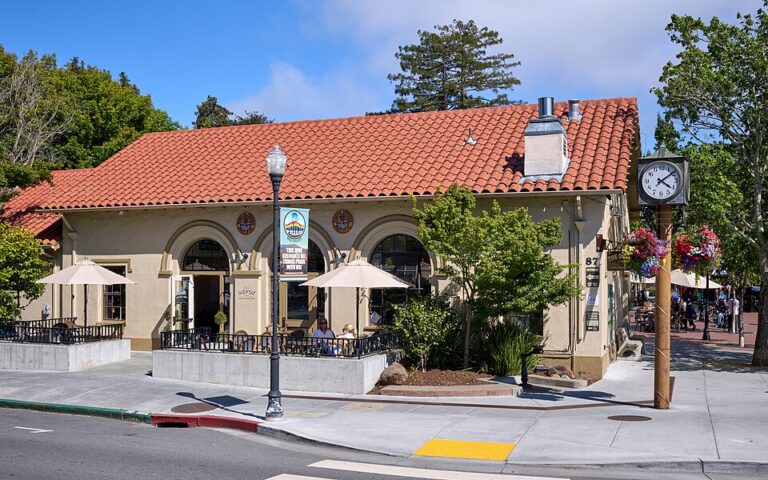
Nineteen pedestrians were involved in Mill Valley’s injury collisions from 2017 through 2021, and about 74 percent were in a crosswalk. Drivers failing to yield to a pedestrian caused 47 percent of those collisions, pedestrians were found at fault in 32 percent, and unsafe speed caused 11 percent. The pedestrian hot spots were on Miller Avenue at the Depot Plaza and at Miller Avenue and Reed Street.
A driver must yield to a pedestrian in a marked or unmarked crosswalk under Vehicle Code § 21950. When an insurer argues the pedestrian was partly to blame, California’s comparative fault rule from Li v. Yellow Cab Co. reduces the recovery by that share rather than barring it. The plan also found that older adults were involved in 28 percent of Mill Valley’s injury collisions, against 20 percent countywide. For an older pedestrian, a hip or wrist fracture can change daily life for months, and the claim has to account for that.
Bike crashes on Miller Avenue and East Blithedale
Of Mill Valley’s 21 collisions involving a bicyclist from 2017 through 2021, 18 involved a motor vehicle. In those, unsafe speed was the leading factor (28 percent), followed by a road user on the wrong side of the road (22 percent), improper turning, and other hazardous violations (11 percent each). Bike crashes clustered on Miller Avenue from Montford Avenue to Camino Alto and at East Blithedale Avenue and Lomita Drive.
- Passing. A driver passing a bicyclist must leave at least three feet, under Vehicle Code § 21760, and slow down or wait when that is not possible.
- Direction of travel. A bicycle on the roadway or shoulder must travel in the same direction as traffic under Vehicle Code § 21650.1. Insurers raise this rule in wrong-side cases, but it does not excuse a driver who could have avoided the rider.
- Car doors. No one may open a door into traffic unless it is reasonably safe, under Vehicle Code § 22517, a real issue along downtown curbside parking.
- Coverage. When the driver has little or no insurance, your own uninsured and underinsured motorist coverage can apply even though you were on a bicycle.
Just outside the city: Shoreline Highway, Panoramic Highway, and Strawberry
Some of the most serious southern Marin crashes happen on roads people think of as Mill Valley but that sit outside the city. The same County plan, in its chapter on unincorporated Marin, reports:
- Shoreline Highway (Highway 1), from Highway 101 to Panoramic Highway: 51 collisions from 2017 through 2021, four with severe injuries. Unsafe speed caused 35 percent, and a third involved bicyclists. The hot spot was between Tamalpais Valley Junction and Tennessee Valley Road, where the commercial uses are.
- Panoramic Highway, from Shoreline Highway to Gravity Car Road: 21 collisions, ten of them involving motorcyclists and six involving bicyclists. The plan describes motorcycle hot spots on twisting rural roads, including Panoramic.
- East Blithedale Avenue at Tower Drive and Kipling Drive: an unincorporated intersection in the County’s high-collision network.
Source: 2024 Marin County Local Road Safety Plan, Chapter 18 (Unincorporated Marin County), Tables 18.1 and 18.2 and the Shoreline Highway analysis.
These crashes are generally CHP reports. If the road itself contributed, the claim goes to whoever owns it: Shoreline Highway and Highway 101 are state highways, so the claim goes to the State, filed with Caltrans for smaller highway damage claims or through the Department of General Services for larger ones, while a county road goes to the County of Marin.
E-bikes and young riders in Mill Valley
The Mill Valley Police Department’s e-bike page describes an e-bike program begun in 2021 in which a juvenile cited for a first offense may, at the officer’s discretion, take a two-hour safety class instead of a traditional citation, with a separate session for parents. The same page says that since July 1, 2025, riders under 16 may not ride Class 2 (throttle) e-bikes under the local ordinance. State law separately bars riders under 16 from Class 3 e-bikes and requires helmets for anyone on a Class 3, under Vehicle Code § 21213.
When a young rider is hurt, a citation or an age-rule violation is not the end of the analysis. The driver’s conduct still matters, and comparative fault applies to minors too. The two-year lawsuit deadline is generally paused until age 18 under Code of Civil Procedure § 352, but a claim against the City, Caltrans, or a school district still runs on the six-month government claim clock. Because the deadline depends on the facts, it is better to have a licensed California attorney determine the deadline that applies than to calculate it yourself.
Filing a claim against the City of Mill Valley
According to the City’s claims page, a claim is made on the City of Mill Valley Claim Form, with supporting documents attached, and sent by email to the Finance Department or by mail to City of Mill Valley, c/o Finance Department, 26 Corte Madera Avenue, Mill Valley, CA 94941. The City forwards claims to its claims adjusters, AIMS, who make a recommendation to the City.
A claim for personal injury against a public entity is generally due within six months under Government Code § 911.2. To hold the City responsible for the condition of a street, the claimant generally must show a dangerous condition that the City created, or knew or should have known about in time to fix, under Government Code § 835. A lawsuit, if one follows, is generally filed in the Marin County Superior Court, 3501 Civic Center Drive, San Rafael.
Atención en español
Sami Sedghani habla español con fluidez. Si usted o un familiar resultó lesionado en Mill Valley, puede llamar al (415) 835-4448 para una consulta gratuita. Dentro de la ciudad, el informe lo hace el Departamento de Policía de Mill Valley. En Tamalpais Valley, Homestead Valley, Strawberry, la autopista 101 y la carretera Shoreline, generalmente lo hace la CHP. El plazo para presentar un reclamo contra la ciudad o el estado generalmente es de seis meses. Como el plazo depende de los hechos, es mejor que un abogado con licencia en California determine el plazo que aplica en su caso, en lugar de calcularlo por su cuenta. Esta información es general y no constituye asesoría legal.
How we prepare a Mill Valley injury case
We start with the location. Inside or outside the city limits, city street or state highway, the answer decides who has the report, who may share responsibility, and which deadline applies. Then we turn to the medical records. I trained as a clinical pharmacist at UCSF, and we read those records the way the defense will, looking at medication history, gaps in care, prior complaints, and whether the notes connect the crash to the diagnosis. Before founding Synergist Law, I spent nine years at large law firms representing companies in complex litigation, so I know how an insurer builds its evaluation. Neither background predicts an outcome. It shapes how we prepare.
Nearby: Sausalito injury claims, Tiburon injury claims, Larkspur injury claims, Corte Madera injury claims, and Kentfield injury claims. For the countywide picture, see our Marin County personal injury lawyer page.
Frequently asked questions about Mill Valley injury claims
Who handles a car accident in Mill Valley?
Inside the city limits, the Mill Valley Police Department at 1 Hamilton Drive. On Highway 101, Shoreline Highway, and in unincorporated areas with Mill Valley addresses, such as Tamalpais Valley, Homestead Valley, and Strawberry, the California Highway Patrol’s Marin Area office generally handles the collision.
How do I get a Mill Valley police report?
The Mill Valley Police Department’s forms page has a Report Request form that can be emailed, faxed, mailed, or brought to 1 Hamilton Drive. Reports are mailed only to the address listed in the report, or picked up in person. The department says it responds within 10 days and that fees may apply.
Which Mill Valley streets have the most injury crashes?
The 2024 Marin County Local Road Safety Plan found that Camino Alto between Miller Avenue and East Blithedale Avenue had the most injury collisions in the city from 2017 through 2021, 23. Downtown Throckmorton Avenue had the highest collision rate. Pedestrian hot spots were on Miller Avenue at the Depot Plaza and at Reed Street.
Is a crash on Shoreline Highway in Tam Valley a Mill Valley police case?
Usually not. Tamalpais Valley is unincorporated Marin County and Shoreline Highway is a state highway, so the California Highway Patrol generally takes the report. A claim based on the condition of a state highway goes to the State, through Caltrans or the Department of General Services depending on the amount, not to the City of Mill Valley.
How long do I have to file a claim against the City of Mill Valley?
A claim for personal injury against a city or other public entity is generally due within six months of the injury under Government Code section 911.2, and a lawsuit against a private party is generally due within two years under Code of Civil Procedure section 335.1. Because the deadline depends on the facts, it is better to have a licensed California attorney determine the deadline that applies than to calculate it yourself.
Can a rider under 16 use a throttle e-bike in Mill Valley?
No. The Mill Valley Police Department states that since July 1, 2025, riders under 16 may not ride Class 2 e-bikes under the local ordinance, and state law already bars riders under 16 from Class 3 e-bikes. If a young rider is hurt, the driver’s conduct is still evaluated, and the rider’s age-rule violation is weighed under comparative fault rather than ending the claim.
Talk to a lawyer about a Mill Valley injury
If you were seriously hurt in Mill Valley or on the roads around it, we can review the report, the insurance, and your medical records with you and identify the deadlines that apply. Call (415) 835-4448 or request a free consultation. Se habla español. Office: 1299 4th Street, Suite 301, San Rafael, CA 94901.
Contingency fee: no attorney’s fee unless we obtain a recovery for you. Depending on the terms of your written fee agreement, you may be responsible for case costs we advance even if there is no recovery. Your fee agreement explains this before representation begins.
Local procedures, projects, and data described here may change after the date shown above. Every case turns on its own facts, and nothing on this page predicts any outcome, timeline, or value in your matter.