
By Sami Sedghani, Pharm.D., J.D. · Synergist Law, P.C. · San Rafael, California · Updated October 28, 2026
This page provides general information only about California law and about motorcycle crash data published by public agencies in Marin County. It is not legal advice, and reading it does not create an attorney-client relationship. Every case depends on its own facts. For advice about your situation, consult a licensed California attorney.
A motorcycle accident lawyer in Marin County starts with a local fact: riders are involved in a small share of injury crashes here but a much larger share of the crashes in which someone is killed or seriously injured. The 2024 Marin County Local Road Safety Plan, prepared by the Transportation Authority of Marin, the County, and Marin’s 11 cities and towns, found that motorcyclists were involved in 7% of injury collisions on the county’s non-state arterial and collector roads from 2017 to 2021, but in 13% of the collisions in which someone was killed or seriously injured. That gap shapes how these cases are investigated and how fault is argued.
Countywide injury data for drivers, cyclists, and pedestrians is on our Marin County personal injury page, and crashes between two cars are covered on our car accident page.
Motorcycle accidents in Marin County: what the local crash data shows
The Local Road Safety Plan used injury and fatal collision data from SafeTREC’s Transportation Injury Mapping System for 2017 through 2021. It counted only crashes on non-state arterial and collector roads, so state highways, including Highway 101, are outside its main analysis. The plan reports:
- Severity. About 20% of collisions involving a motorcycle were fatal or severe injury collisions, and 2% were fatal.
- Causes. Unsafe speed was the primary collision factor in 35% of motorcycle collisions. Improper turning and automobile right-of-way violations (a driver failing to yield to another vehicle that had the right-of-way) each accounted for another 20%.
- Solo crashes. 47% of motorcycle collisions involved no other party. Half of those were attributed to unsafe speed.
- Hotspots. The plan identified motorcycle collision hotspots in downtown San Rafael, downtown Novato, and along sections of Panoramic Highway.
A crash coded as “solo” is not always the whole story. Gravel in a curve, a broken pavement edge, or a car that forced the rider wide and kept going can all end up recorded as a single-vehicle crash.
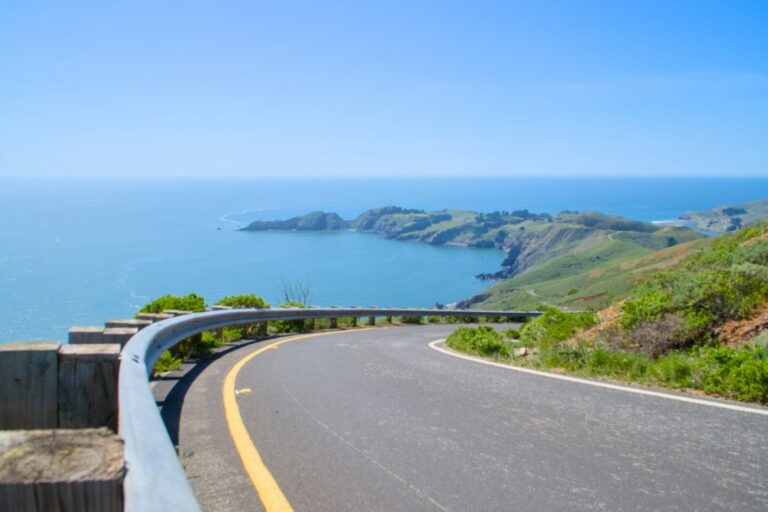
Rural roads in unincorporated Marin
In unincorporated Marin, the plan counted 52 motorcycle collisions: 40 solo, nine involving a motor vehicle, and three involving a bicycle. Solo crashes there were mostly attributed to unsafe speed (55%) and improper turning (35%), with hot spots along twisting rural roads, including Panoramic Highway and Lucas Valley Road. The plan’s High Collision Network includes these three segments, with Panoramic Highway standing out:
| Road segment (unincorporated Marin) | Injury and fatal collisions, 2017-2021 | Involving a motorcycle |
|---|---|---|
| Panoramic Highway, Shoreline Highway to Gravity Car Road | 21 | 10 |
| Point Reyes-Petaluma Road, Novato Boulevard to Nicasio Valley Road | 22 | 4 |
| Lucas Valley Road, Bay Laurel Lane to Camino Margarita (Big Rock) | 9 | 1 |
Motorcycle crashes on San Rafael and Novato streets
In town, the pattern flips toward crashes with cars. Of 35 motorcycle collisions in San Rafael, 30 involved a motor vehicle. Those were largely attributed to automobile right-of-way violations (47%) and improper turning (30%), with a hotspot at Hetherton Street and 2nd Street downtown. In Novato, about 69% of motorcycle collisions involved a motor vehicle, mainly from automobile right-of-way violations (35%), with crashes spread through the city, particularly along South Novato Boulevard and Redwood Boulevard. Street-level data for each city is on our San Rafael injury page and Novato injury page.
How Marin compares statewide
The California Office of Traffic Safety publishes yearly county rankings. Its 2023 Marin County results list 89 motorcyclists killed and injured and rank Marin 41st of 58 counties for motorcycle victims. According to OTS, counties are ranked statewide using a method that weighs crash counts together with population and vehicle miles traveled, and number 1 is the highest, or “worst.” OTS calls its rankings only indicators of potential problems.
Lane splitting accidents in California: legal, but still argued
Vehicle Code section 21658.1, in effect since January 1, 2017, defines lane splitting as driving a two-wheeled motorcycle between rows of stopped or moving vehicles in the same lane. It lets the California Highway Patrol develop educational safety guidelines but sets no lane-splitting speed limit. Our article on whether lane splitting is legal in California covers the law’s history and other rider rules.
The CHP’s motorcyclist safety page states that lane splitting by motorcyclists is legal in California. Its guidance says danger increases at higher speed differentials and as overall speed increases. It also advises against splitting next to big rigs, buses, and motorhomes. The same page states that riding on the shoulder is illegal and is not lane splitting, and that intentionally blocking or impeding a motorcyclist in a way that could cause harm, or opening a door to impede one, is illegal. Vehicle Code section 22517 separately bars opening a door on the traffic side unless it is reasonably safe.
Because the guidance is advisory, fault in a lane-splitting crash usually turns on how both people moved. The driver’s insurer may point to the rider’s speed compared with traffic; the rider’s side may point to a driver who changed lanes without checking. Section 21658(a) requires a vehicle on a road with two or more marked lanes in one direction to stay as nearly as practical within a single lane and not move from it until the movement can be made with reasonable safety, and section 22107 requires a signal when another vehicle may be affected. California uses pure comparative fault under Li v. Yellow Cab Co. (1975) 13 Cal.3d 804, so a rider found partly at fault has damages reduced in proportion to that share rather than barred.
Left turns, lane changes, and rear-end crashes
Right-of-way violations and improper turns run through the Marin data, and the left turn across a rider’s path is the classic version. Under Vehicle Code section 21801(a), a driver turning left or making a U-turn must yield to all vehicles approaching from the opposite direction that are close enough to be a hazard at any time during the turn, and must keep yielding until the turn can be made with reasonable safety. The duty runs to every approaching vehicle, motorcycles included.
Other rules that come up often:
- Following too closely. A driver may not follow another vehicle more closely than is reasonable and prudent, considering speed, traffic, and the roadway (§ 21703).
- Basic speed law. No one may drive faster than is reasonable or prudent for weather, visibility, traffic, and the surface and width of the road (§ 22350). It applies to the driver and to the rider alike.
Sightlines matter too. A parked truck, a hedge, or a hillside curve can hide a motorcycle’s narrow profile, and when a view was blocked, the next question is who controlled the obstruction.
Helmet law and comparative fault
California requires every motorcycle driver and passenger to wear a safety helmet on the highway (Vehicle Code § 27803). Helmets sold for motorcycle use must meet state standards that include Federal Motor Vehicle Safety Standard No. 218 and carry the federal certification label (§ 27802). Under section 27803(e), a helmet counts as worn only if it is fastened with the straps and fits securely without excessive movement.
The helmet statutes do not say how a missing or loose helmet affects an injury claim. Insurers may argue that a compliant, fastened helmet would have reduced a head injury and that damages should be reduced as comparative fault. That argument generally has little bearing on a broken leg or on who caused the crash. A helmet also does not rule out a traumatic brain injury.
Who may be responsible, and what insurance may pay
The identity of the defendant often matters as much as the injury, because it controls what coverage exists.
- An individual driver. For policies issued or renewed on or after January 1, 2025, California’s minimum bodily injury limits are $30,000 per person and $60,000 per accident (Vehicle Code § 16056). If someone else owned the car and allowed the driver to use it, the owner can be liable under § 17150, but that owner liability is capped at $15,000 per person and $30,000 per accident when it does not arise from an employment or agency relationship (§ 17151).
- A business or commercial vehicle. A principal is responsible for an agent’s negligence in the business of the agency (Civil Code § 2338). When a work vehicle causes the crash, the employer’s commercial auto and umbrella policies may be involved. Large-truck crashes are covered on our truck accident page.
- A public entity. Under Government Code section 835, a public entity can be liable for a dangerous condition of its property if an employee created it or the entity had notice in time to protect against it, among other elements. A written claim must generally be presented within six months under section 911.2. For County roads, claims go to the County of Marin through the Clerk of the Board of Supervisors, 3501 Civic Center Drive, Room 329, San Rafael. For state highways, Caltrans accepts claims of $12,500 or less directly, and larger claims go to the Department of General Services’ Government Claims Program. Because the deadline depends on the facts, it is better to have a licensed California attorney determine the deadline that applies than to calculate it yourself.
- A product manufacturer. A failed tire, brake, or helmet can point to a product liability claim.
Your own motorcycle policy
Your own uninsured and underinsured motorist coverage may matter, depending on the policy language. Under Insurance Code section 11580.2, a bodily injury liability policy covering a motor vehicle in California must include uninsured motorist coverage unless the named insured deletes it or lowers it by a written agreement, and the statute’s definition of an uninsured vehicle includes an underinsured one. A motorcycle is a motor vehicle under Vehicle Code section 400. See our article on uninsured and underinsured motorist claims in California.
Hit-and-run crashes raise a motorcycle-specific problem. When the at-fault driver is never identified, section 11580.2(b) conditions coverage on physical contact between that vehicle and the insured or “an automobile that the insured is occupying,” and on a report of the accident within 24 hours to the city police or, in unincorporated territory, to the Marin County Sheriff’s Office or the CHP, followed by a sworn statement to the insurer within 30 days. A car that cuts a rider off without touching the bike can leave a hard coverage question. Because the deadline depends on the facts, it is better to have a licensed California attorney determine the deadline that applies than to calculate it yourself.
Prop 213, medical bills, and where a case is heard
Riding uninsured carries a specific cost. Civil Code section 3333.4, enacted by Proposition 213, bars non-economic damages for an injured owner whose vehicle was not insured as required, an operator who cannot establish financial responsibility, or a person convicted of DUI in the crash. Economic losses are not barred. Subdivision (c) carves out an uninsured owner injured by a driver convicted of DUI for the crash, and the California Supreme Court has held that the statute does not apply to a product liability claim against a vehicle manufacturer (Hodges v. Superior Court (1999) 21 Cal.4th 109). How these exceptions apply to a rider who both owned and was operating the motorcycle depends on the facts.
Recoverable past medical expenses are generally limited to the amounts actually paid or still owed, not the full billed charges, under Howell v. Hamilton Meats & Provisions, Inc. (2011) 52 Cal.4th 541. If a case is filed, Code of Civil Procedure section 395 makes the superior court in the county where the injury occurred a proper court, so a Marin crash is often heard in Marin County Superior Court.
What matters in the first days after a motorcycle crash in Marin County
Which agency has the report depends on where the crash happened. The CHP has primary responsibility for investigating crashes on state freeways (Vehicle Code § 2400(d)), and crashes on other state highways and roads in unincorporated Marin, including Panoramic Highway, Lucas Valley Road, and Point Reyes-Petaluma Road, are generally handled by the CHP, which provides traffic enforcement on non-freeway roads in unincorporated areas under its General Order 100.69. For those crashes, the report usually comes from the CHP’s Marin Area office at 53 San Clemente Drive in Corte Madera. Involved parties can request CHP reports through its crash report request page. Crashes on city streets usually go to that city’s police, such as the San Rafael Police Department or the Novato Police Department.
Motorcycle cases depend on physical evidence that is easy to lose:
- The helmet and gear. Scuffs and cracks on a helmet, jacket, and boots show where and how hard the rider hit. Once discarded, that evidence is gone.
- The motorcycle. Paint transfer and fork and frame damage help reconstruct the impact. Repairs or a salvage sale can erase them, along with any data stored in the bike’s electronic modules.
- The other vehicle’s data. If the other car has a manufacturer-installed event data recorder, Vehicle Code section 9951 generally bars anyone other than the registered owner from downloading its data without the owner’s consent or a court order, subject to limited exceptions.
- The road. Photos of gravel, potholes, and the driver’s line of sight matter in a public-entity claim, and crews may repair a spot within days.
- Video. Helmet cameras, dashcams, and doorbell and business cameras are often recorded over quickly.
An insurer may ask for a recorded statement early. Hold off on recorded statements until you consult with a licensed attorney.
Our pages on catastrophic injuries, spinal cord injuries and paralysis, and amputations cover those cases. When future care needs are at issue, a life care plan is prepared by a credentialed life care planner. When a rider does not survive, see our wrongful death page.
How we prepare a motorcycle injury case in San Rafael and Marin County
We start with the road and the bike. Where did the impact happen, and what did the road look like at that spot? We gather the report, photos, video, and vehicle data, send preservation letters early, and identify every defendant and policy, including the rider’s own coverage.
Insurers often dispute fractures that heal with lasting limits and concussions without a visible scan finding. Before founding Synergist Law, Sami trained as a pharmacist at UCSF and spent nine years at large law firms representing companies in complex and product liability litigation. We read the medical records looking at what the defense will question: medication history, gaps in care, prior conditions, and whether the chart ties the symptoms to the crash. Neither background predicts how a case will turn out. Both shape how we prepare one.
Atención en español
Si usted o un familiar resultó herido en un accidente de motocicleta en el condado de Marin, puede hablar directamente con nosotros en español. Sami habla español con fluidez. Llame al (415) 835-4448. Nuestra oficina está en 1299 4th Street, Suite 301, San Rafael. Esta información es general y no constituye asesoría legal.
Motorcycle accident lawyer FAQ
Is lane splitting legal in California?
Yes. Vehicle Code section 21658.1 defines lane splitting, and the CHP states that it is legal in California. The statute sets no lane-splitting speed limit. CHP guidance warns that danger increases with speed and with the speed difference between the motorcycle and traffic, and riding on the shoulder is not lane splitting.
Who is at fault in a lane splitting accident in California?
It depends on how each person moved. On a road with two or more marked lanes in one direction, a driver must stay within a lane and change lanes only when it can be done with reasonable safety (Vehicle Code § 21658(a)), and the rider must ride at a reasonable speed for conditions (§ 22350). Under California’s pure comparative fault rule, a rider found partly at fault has damages reduced by that share rather than barred.
Can I recover if I was not wearing a helmet?
Riding without a helmet violates Vehicle Code section 27803 but does not by itself bar an injury claim. Insurers may argue that a helmet would have reduced a head injury and that damages should be reduced as comparative fault. That argument generally has little bearing on injuries a helmet would not have affected, or on who caused the crash.
Can I recover if my motorcycle was uninsured?
Partly. Under Civil Code section 3333.4 (Proposition 213), an injured owner whose vehicle was not insured as required, or an operator who cannot show financial responsibility, generally cannot recover non-economic losses such as pain and suffering in a claim against another motorist. The statute does not bar economic losses such as medical bills and lost earnings. It has a narrow exception for an uninsured owner injured by a driver convicted of DUI for the crash, and the California Supreme Court has held that it does not apply to a product liability claim against a vehicle manufacturer.
Who pays after a motorcycle accident in California?
If another driver was at fault, that driver’s auto liability insurance is usually the first source. Depending on the facts, an employer, a vehicle owner, a manufacturer, a public agency, or the rider’s own uninsured or underinsured motorist coverage may also be involved. Hold off on recorded statements until you consult with a licensed attorney.
What if the driver who caused my motorcycle crash was never identified?
Your own uninsured motorist coverage may apply, depending on the policy. For an unidentified driver, Insurance Code section 11580.2(b) generally requires physical contact, a report within 24 hours to the city police where the crash happened (or, in unincorporated areas, to the sheriff or the CHP), and a sworn statement to the insurer within 30 days. Because the deadline depends on the facts, it is better to have a licensed California attorney determine the deadline that applies than to calculate it yourself.
How long do I have to file a motorcycle accident claim in California?
For most injury claims, the general rule is two years from the injury under Code of Civil Procedure section 335.1. A claim against a public entity, for example over a dangerous road condition, generally must be presented within six months under Government Code section 911.2. Different rules can apply to injured minors, including for claims against public entities (CCP § 352; Gov. Code § 911.6). Because the deadline depends on the facts, it is better to have a licensed California attorney determine the deadline that applies than to calculate it yourself.
Is there a motorcycle accident attorney in San Rafael?
Yes. Synergist Law’s office is at 1299 4th Street in downtown San Rafael, and we handle motorcycle injury cases from San Rafael and throughout Marin County. San Rafael crash data is on our San Rafael injury page.
Talk to a motorcycle accident lawyer in Marin County
If you or a family member was seriously hurt in a motorcycle crash, we can review the report, the bike, the insurance, and the medical records. We take cases from San Rafael, Novato, West Marin, and the rest of the county. The firm is led by Sami Sedghani, Pharm.D., J.D. Call (415) 835-4448 or request a free consultation. More answers are on our personal injury FAQ page. Se habla español. Office: 1299 4th Street, Suite 301, San Rafael, CA 94901.
Contingency fee: no attorney’s fee unless we obtain a recovery for you. Depending on the terms of your written fee agreement, you may be responsible for case costs we advance even if there is no recovery. Your fee agreement explains this before representation begins.
Motorcycle laws, insurance requirements, and agency crash data described here may change after the date shown above. Every case turns on its own facts, and nothing on this page predicts any outcome, timeline, or value in your matter.